



As every company grows and data flows across teams and systems management, a lack of uniformity in brand name entries can lead to severe issues, like data misalignment and customer loss. It is differences in spelling, punctuation, or abbreviations that cause discontinuity in analytics and a disorganized brand image of every company. Without brand-name normalization rules and regulations, the inconsistencies can hinder brand growth and erode trust.
In this article, we will explore the importance of brand name normalization and explore the key rules for ensuring consistency across systems. In addition, we will also learn the pitfalls that businesses can fall into during this process, how to prevent them and what tools and strategies make your brand name management easier.
What Is Brand Normalization?
Simple: you take all the random versions of a brand name floating around and smash them into one clean, standard version. Same name everywhere—databases, CRMs, catalogs, SEO, all of it.
Here’s how it usually goes:
- Find the mess: Look through your stuff and spot where brand names are all over the place.
- Clean it up: Strip out weird spacing, bad punctuation, typos—all that junk.
- Lock in a standard: Pick the official version and actually stick to it.
- Kill duplicates: Merge repeat entries into one record so you’re not counting the same thing twice.
- Do it right and your sales tracking actually works. Your supply chain stops tripping over itself, too.

Why Bother?
Clean brand names aren’t just nice to have—they’re money:
- Data that you can trust: No more confusion about which version is right.
- Customers can search for you: Naming is consistent, which helps customers to search.
- Customers look for you: Customers can search and your SEO benefits.
- Reduced duplication of “junk” – Deduplication helps to maintain thin databases.
- Brand people remember: When people see the same name all the time, they remember it.
- You’re professional-ready: A uniform name conveys your knowledge.
- Stopping the battle of the names: Teams work better when everyone relies on the same approved name.
Real numbers:
- 75% of companies reported that cross-system analytics improved since normalizing.
- Dropping of duplicate entries up to 90%.
- The speed of the operations improves by approximately 25%.
- The number of search/recommendation errors decreases.
- The cost of upkeep decreases since you’re not always having to clean up after yourself.
Read Also: 5starsstocks.com Nickel Market Insights: Demand, Supply and Investment Strategies
The Headaches You’ll Run Into
- Capitalization, Punctuation and Abbreviations
People type stuff differently. “H & M”, “H&M”, “h m”—same brand, three versions. “Apple”, “apple”, “APPLE”—systems treat them like different companies. You need rules that catch this.
- Mergers, Rebrands, and Subsidiaries
Brands change. A parent company buys a smaller one. A legacy name hangs around after a rebrand. Figuring out how to handle these relationships in your data gets tricky fast.
- Regional Names and Translations
Same brand, different spelling depending on the country. Accents, diacritics and local characters—your system might not handle them well, which complicates everything.
- Typos and User Errors
People misspell names in searches, reviews and product listings. “Adidas” becomes “Adiddas.” Those errors create duplicate or broken records that pollute your analytics.
The Rules That Actually Work
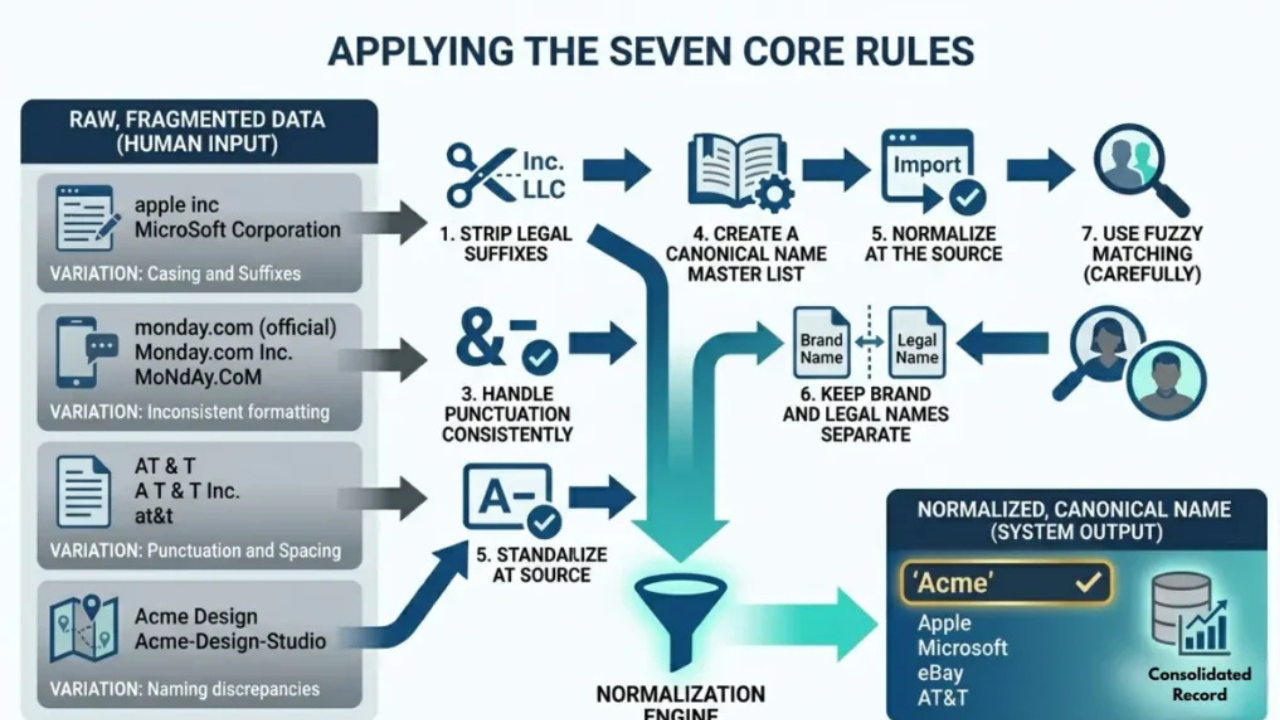
- Pick One Official Version
Choose the real brand name—the one on legal docs or the official website. That’s your standard.
- Right: Coca-Cola
- Wrong: Coca-Cola, Coca Cola, COCA-COLA
- Lock in Capitalization
Pick a case format and enforce it everywhere. Title Case usually works best.
- Right: Nike
- Wrong: NIKE, nike
- Strip Legal Junk Unless You Need It
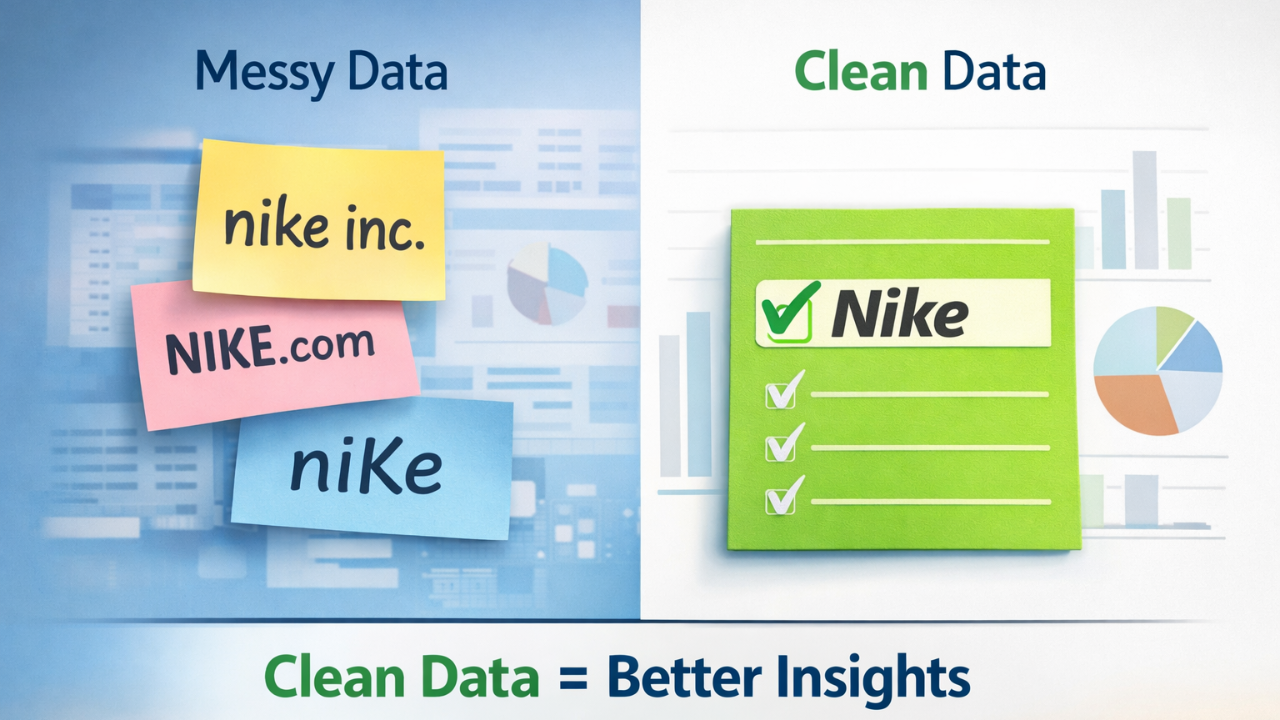
“Inc”, “LLC”, “Ltd”—toss them unless legal specifically requires them.
- Right: Nike
- Wrong: Nike Inc, Nike LLC, Nike Ltd
- Clean Punctuation and Special Characters
Remove extra periods, commas and random symbols unless they’re part of the official name. Handle accents based on what your system can actually process.
- Right: Cafe Nero
- Wrong: Café Nero (if your system chokes on accents)
- Fix Spacing
No leading spaces, no trailing spaces, no double spaces in the middle.
- Right: Apple Inc
- Wrong: ” Apple Inc.”
- Handle Abbreviations Consistently
Decide once: expand them or keep them short? Either way, stick to it.
- “Co” → “Company” or keep “Co.”
- “Intl” → “International” or keep “Intl.”
- Keep a Lookup Table
Map every known variation to your standard name. Saves you from reinventing the wheel every time.
- “Samsung Electronics” and “Samsung Electronics L&T” → both map to “Samsung”
- Write It Down and Enforce It
Document your rules in a style guide. Make sure everyone touching your data pipeline actually follows them.
How to Roll This Out
- Audit Your Data
Dig into your datasets. See how bad the damage is. Figure out which variations are the biggest problems.
- Set Your Standards
Write down your rules. Make them clear enough that anyone on your team can follow them without asking questions.
- Build a Mapping Dictionary
List every variation you’ve found and map it to your clean, standard version. This becomes your reference bible.
- Automate the Boring Stuff
Small datasets? Manual cleanup works. Anything bigger? Use tools. Scripts, specialized software, whatever gets the job done without human hands on every entry.
- Test Before You Go Live
Run your rules on sample data first. Compare before and after. Make sure you’re not breaking things.
- Push It Everywhere
Once it works, roll it out across your whole organization. Build normalization into your data pipelines so new stuff gets cleaned automatically.
- Keep Checking
This isn’t a one-and-done project. New data keeps coming. Audit regularly to catch drift.
7 Expensive Mistakes and How to Avoid Them
Mistake 1: No Written Rules
Nobody wrote the rules down, so everyone makes up their own. Your data gets worse over time instead of better.
Fix: Create a normalization rulebook. Update it. Explain why the rules exist so people actually care.
Mistake 2: Treating It Like a One-Time Cleanup
You clean everything once, then walk away. New messy data piles up immediately.
Fix: Build normalization into your data entry forms, pipelines, and integrations. Clean at the source, every time.
Mistake 3: Stripping Too Much
You lowercase everything and kill all punctuation. Suddenly, “H&M” becomes “hm” and “3M” becomes “3m”—completely different brands.
Fix: Decide what actually matters and preserve it. Build rules that respect meaningful differences.
Mistake 4: Mixing Up Brand and Business Names
Your brand name and your legal business name aren’t the same thing. Confusing them screws up analytics and management.
Fix: Keep separate processes. Let them align where it makes sense, but don’t force them together.
Mistake 5: Doing Everything by Hand
Manual cleanup takes forever, costs a fortune, and humans make mistakes. It doesn’t scale.
Fix: Automate with rules, scripts, or tools. Only use manual review for weird edge cases the system flags.
Mistake 6: Normalizing Before Deduplicating
You clean the names but leave duplicates hanging around. Your matching logic still breaks.
Fix: Combine deduplication with normalization. Resolve duplicates during cleanup so your data actually works.
Mistake 7: Never Measuring Results
You have no idea if your process is helping or hurting because you’re not tracking anything.
Fix: Set KPIs—normalized entries, match rates, exceptions flagged. Watch them over time and tweak your rules when patterns show up.
Tools That Get the Job Done
| Tool Type | Examples | Best For |
| Enterprise MDM | Talend, Informatica | Big companies with complex data across departments |
| Developer Libraries | FuzzyWuzzy (Python), Cleanco | Engineers building custom database solutions |
| Cloud ETL | Google Cloud Dataflow, AWS Glue | High-speed data pipelines |
| AI/NLP Platforms | MonkeyLearn, OpenAI API | Understanding the context behind name variations |
How to choose:
- Tons of data? Cloud ETL tools scale without choking.
- Need precision? Enterprise MDM handles complex deduplication.
- Quick fix? Python libraries like FuzzyWuzzy for fast audits.
Real Examples:
- Akumin (Healthcare)
They merged a bunch of sub-brands and ended up with 4,000 different email signatures. After standardizing everything, they saw a 5.66% click-through rate boost just from looking unified.
- Amy’s Kitchen (Retail)
Inconsistent product names across retailer feeds broke their analytics. They normalized with Salsify PIM and hit 99.9% accuracy, which bumped marketing-influenced sales by 1–2%.
- Fuji Sports (E-Commerce)
Amazon’s automated system mislabeled about 4,000 SKUs as Fuji Sports. Manual corrections fixed it, but it showed how bad automated matching can get without clean canonical names.
What Actually Works
- Write down every rule. Update them regularly.
- Treat normalization as part of data governance, not a side project.
- Train your teams on the standards.
- Automate wherever possible.
- Watch your results and adjust as your business changes.
Final Word
Messy brand names cost you more than you think. They break analytics, confuse customers, and make your operation look amateur. Normalization—cleaning, standardizing, and deduplicating—should be baked into your data strategy from day one.
Get the rules right, dodge the common mistakes, and pick tools that fit your scale. Whether you’re dealing with CRM data, product catalogs, or records from a dozen different sources, clean brand names pay off in accuracy and trust.
Read More: Techgues com: What It Is, Key Features and Why It Matters in 2026
