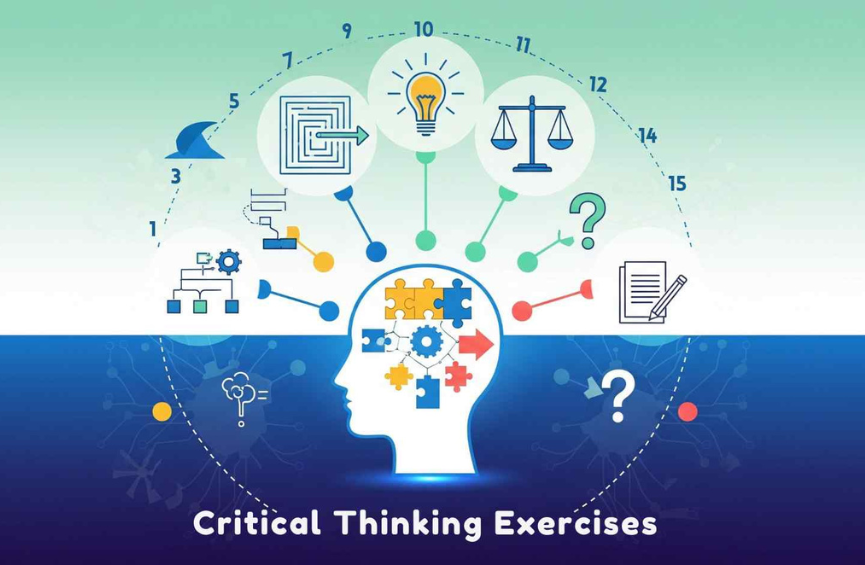
Consider a team that is in a hurry to make a decision without doubting assumptions: deadlines are lost, resources are wasted, frustration occurs. That is what occurs when critical thinking is omitted. In the job, research, or in general life, the skill to stop, examine and assess information is what distinguishes bad decisions and clever resolutions.
Critical thinking assists us to filter noise, bias, and make decisions that can be subjected to scrutiny. In this article, we’ll share practical critical thinking exercises you can start using right now. You will have an easy to use toolkit after reading to think more clearly, solve problems better, and make better decisions in any situation.
The importance of critical thinking
Critical thinking is the art of thought and evaluation, analysis and inference, and reasoning. It involves the ability to distinguish between fact and opinion, doubt assumptions and to consider evidence before making judgments. It is simply a matter of being judgmental and not impulsive.
The advantages are diverse: better decision-making, problem-solving, reduced errors, and creativity. Through critical thinking, people will understand themselves better in complicated scenarios and will be resistant to misinformation.
Critical thinking is taken a step further in business and team environments as it enhances teamwork, creativity and flexibility, enabling organizations to face challenges with confidence. As a student, professional, or a leader, the ability to develop this skill will make sure that you can maneuver through uncertainty and make a significant contribution towards group success.
Core Critical Thinking Exercises to Try
1. Root-Cause Drilling / Five-Whys
Question five times to identify the cause of a problem. As an illustration, when a project is late, do not just stop at the fact that the team was late. Get to the root of the matter: Was it instructions not clearly understood? Resource shortages? Miscommunication? This approach eliminates superficial solutions and guarantees permanent solutions.
2. Inversion Thinking (What Could Go Wrong?)
Rather than posing a question of how we can be successful, ask a question of how we could fail. Through risk identification at an early stage, you can develop protective measures. As an example, in planning a product launch, what could go wrong, such as ineffective marketing, supply chain, or customer confusion, should be thought of and avoided.
3. Separating Facts and Opinions / Argument Mapping
Map arguments, counterarguments, and conclusions. This simplifies thinking and reveals the areas of weakness. Combine it with fact vs. opinion exercises: learn to differentiate between verifiable information (sales increased 15%), and opinion (customers love our product). These in combination enhance analytical clarity.
4. Journaling / Reflective Writing
Keep a decision journal. Record what you believed, the reason you took a course and the result. Trends develop over time, whether it is prejudice, blindness, or strength. Reflection develops self-awareness and contributes to the improvement of future reasoning.
5. Role-Play / Group Activities / Debate Games
Role play with colleagues or peers. Role-play (e.g. as a skeptic, as an optimist, as a risk analyst) and discuss a proposal. This reveals a variety of views and conditions for you to expect resistance. It is particularly handy in a team environment where groupthink will block innovation.
6. Reverse Brainstorming / What Not to Do
Rather than posing the question, how do we solve this? pose the question How could we make it worse? It can be useful to list negative behaviors (e.g. not keeping deadlines, not communicating goals, etc.) to emphasize what not to do. This artistic twist can be used to generate new solutions.
7. Mind-Mapping or Visual Thinking Tools
Relate ideas, causes and effects with the use of diagrams. Mind maps simplify complex issues and promote creative associations. They work well particularly in brainstorming or planning multi-step projects.
How to Embed These Exercises into Daily Life / Work
Begin with a few: select one or two exercises a week. Apply Five-Whys to work issues, use journaling to reflect on oneself, or apply quick argument mapping to news or proposals. Balance between self-awareness and collaboration by combining individual strategies (journaling, mind-mapping) with group ones (debates, role-play).
Stability is more important than vigor. Frequent brief workouts are more habit-forming than infrequent intensive workouts.
Use these exercises in advance: when you begin a project, when you have a challenge to solve, when you are making a decision, not when you have a problem. With time they will become second nature, and will make you sharpen and clearer.
Common Pitfalls & How to Avoid Them
Analysis paralysis: Time-boxing exercises or having specific goals will help to avoid endless overthinking.
Confirmation bias: Test your beliefs; add counterarguments to argument maps.
Groupthink: Promote different opinions and the admiration of disagreement during team activities.
Superficial reflection: Journaling must not be limited to what happened but rather why I thought it was the case and what I would do differently.
Final Word
Critical thinking is not an innate ability, but a skill, just as a muscle, it gets stronger with practice. By practicing these critical thinking exercises, you’ll make smarter decisions, solve problems more effectively, and think with greater clarity in both personal and professional life. Begin now: choose one exercise, use it on a real problem or decision and consider the result. Consistently, you will develop a sharper and stronger mind. To grow further, consider the communities or formal training courses that emphasize critical thinking practice as a team.